Five Bucks Series
A bold, affordable gateway into daring theatre — only at WRP.
The Five Bucks Series is Western Reserve Playhouse’s platform for adventurous, small-scale storytelling at an unbeatable price. What began as a stripped-down play-reading series has grown into a flexible performance space where artists can experiment, stories can take risks, and audiences can experience something new without the formality (or price tag) of a full MainStage production.
For just $5 Bucks, you’ll see:
Intimate, actor-driven performances with light staging or minimal design
Fresh, surprising scripts that challenge, delight, or spark conversation
Single-performance-only experiences you won’t find anywhere else in the region
Five Bucks Series 2026
The Kentucky Cycle
Five Bucks Series 2026 The Kentucky Cycle
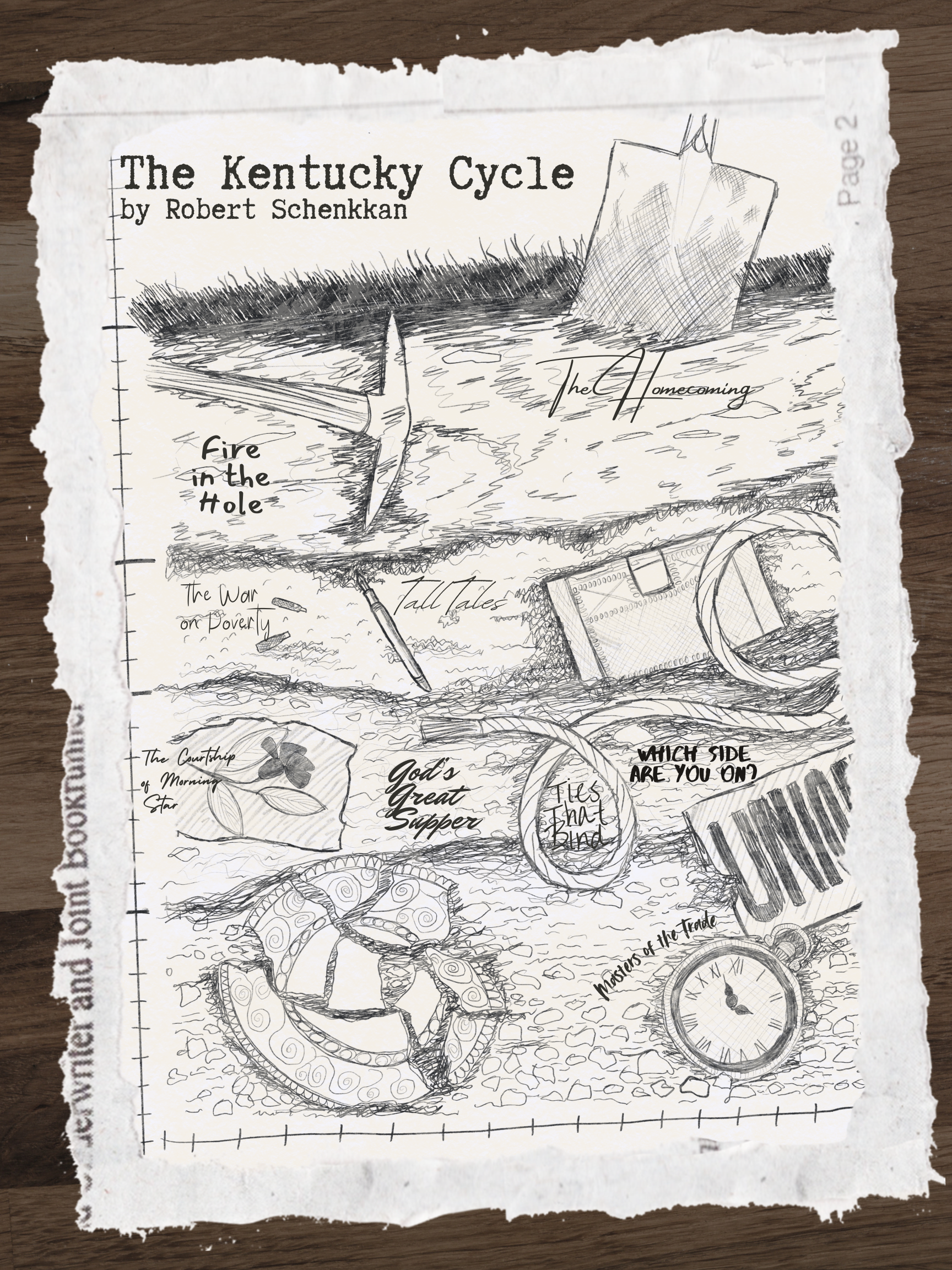
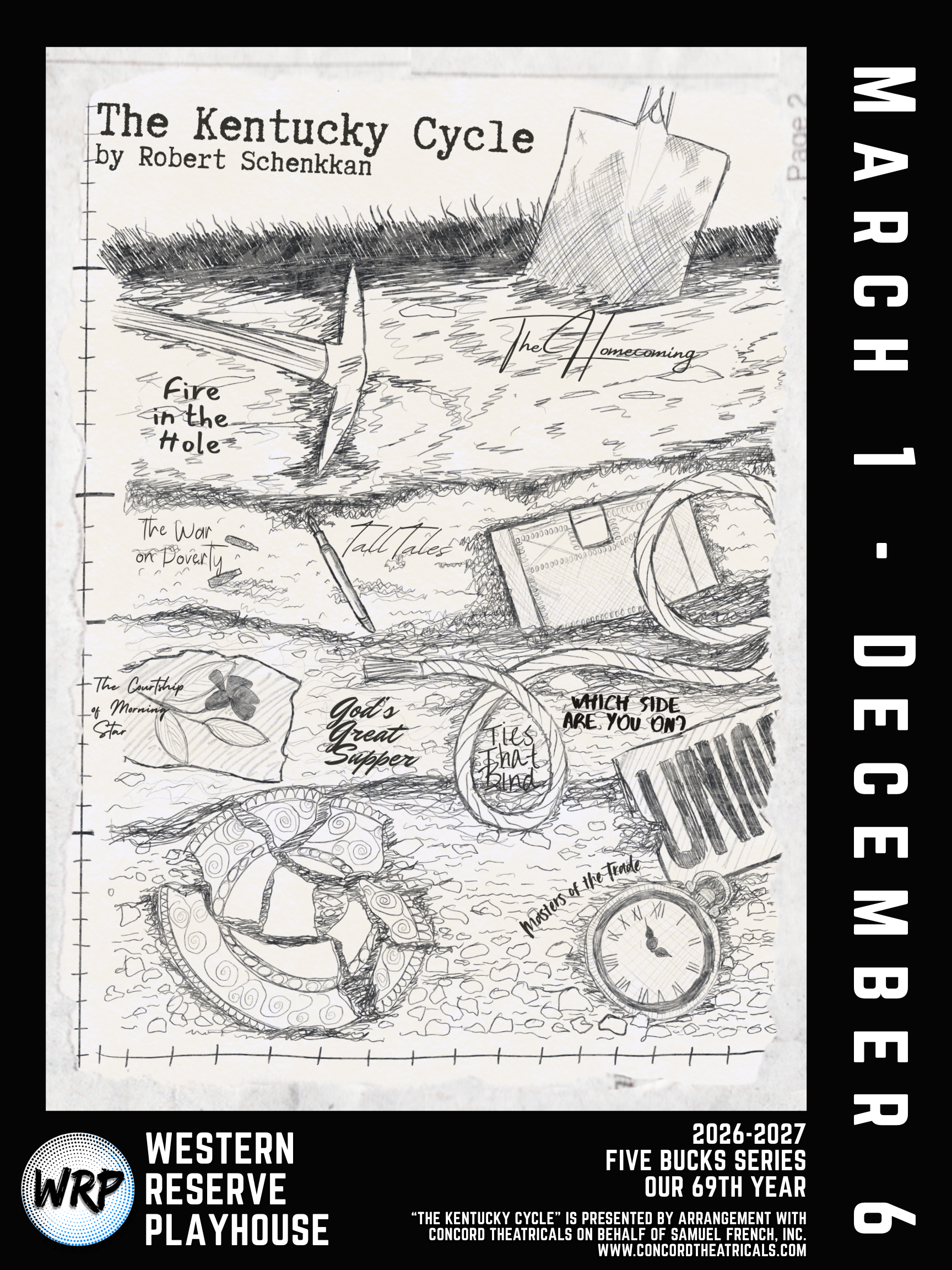
The Kentucky Cycle is an unprecedented, yearlong theatrical event at Western Reserve Playhouse — a sweeping, ten-part epic that unfolds across American history and across our entire 2026 season. Told in a series of standalone but interconnected episodes, the cycle follows four families over 200 years and their legacies of violence, hope, and survival.
Prior to presenting the cycle in it’s entirety December 5 & 6, WRP is bringing The Kentucky Cycle to life throughout the year in an episodic format, allowing audiences to follow the story across months as it builds toward its powerful conclusion.
Attend one episode — or a few — or tune in for the entire journey in two glorious theatrical binge sessions. No matter what, we guarantee that you’ll be a part of this rare theatrical achievement: 200 years of American history as we reflect on 250 years of America’s legacy.
Only at WRP.
1775. Michael Rowen, an indentured servant from Ireland, watched his wife and children massacred by Indians. Determined to survive in the hostile wilderness of Eastern Kentucky, he swindles an old trapper, murders an innocent boy and sets up gun trade with the Indians. They give him land he craves with a warning that it is haunted; in return, Rowen promises more gunpowder and gives them blankets tainted with smallpox. Clutching a gold watch stolen from the dead trapper, Rowen sets in motion a legacy of corruption that will curse his valley and its people for generations to come.
THE COURTSHIP OF MORNING STAR. 1776. Into the hut built on his homestead, Rowen takes a wife by kidnapping Morning Star, a young Indian girl whose tribe has been ravaged by smallpox. To keep her from escaping, he cuts the tendon of her leg. Although she hates Rowen, she loves the child she bears for him, believing the baby to be a true son of her lost people, for whom she mourns the rest of her life.
1792. Michael Rowen returns home from Louisville with news that Kentucky has become a state and with a young black slave woman he has bought with the idea of breeding a second family. Morning Star fears his treachery, remembering when he took their infant daughter and buried her alive because he didn't want a girl. Morning Star warns Patrick, now a young man who wants to marry Rebecca Talbert, the daughter of their neighbor Joe Talbert, that Michael will never give him the family land. Enraged, Patrick murders Michael just before the Talberts arrive. Joe Talbert, in love with Morning Star, refuses to overlook the crime. Patrick then kills him, banishes his mother from the homestead, and marries the dead man's daughter.
1819. Patrick Rowen, as land hungry as his father before him, fights desperately to keep his land before a corrupt judge about to foreclose on the property. As his sons, Zeke and Zach, watch in horror, Patrick trades off everything he possesses to a stranger who holds the note on the land. When he offers to sell the slave, Sally, and her son, Jessie, Sally pleads for her son, revealing that he is in fact Patrick's brother. Even this does not stop Patrick from sacrificing Jessie. When he has given up everything, the stranger introduces himself as Jeremiah Talbert, the brother of Patrick's dead wife.
1861. The Rowen family has worked hard and long as poor sharecroppers, their land now owned by Richard Talbert, an arrogant aristocrat and son of Jeremiah. Patrick, now 86 and disabled by a stroke, lives in poverty with the pious Zeke and his family. Richard Talbert convinces Zeke's son, Jed, to join him in fighting with the Confederacy. But Jed, loyal to settling his family's account, murders Richard on the battlefield, and is ushered into the horrors of the Civil War. When Jed returns with his fellow deserters, they burn and destroy the Talbert place, killing the children, slaves and animals, leaving alive only the two Talbert women to witness the slaughter
1890. Greed and deceit catch up with Jed Rowen in the guise of JT Wells, a storyteller who arrives one day to flirt with Mary Anne, Jed's pretty young daughter. After charming the Rowen family with his stories, JT convinces Jed to sell the mineral rights to his land. When Mary Anne saves JT's life, he gives her back the deed, telling her the mining company will strip and ruin the land. Mulish and defiant, Jed refuses to tear up the deed and JT's direst predictions for the beautiful valley come to pass.
1920. Its coal tipple standing where once there were trees, the Blue Star Mining Company owns the valley. If coal is king, the people of the town are peasants, working like slaves in dangerous mines, paid in script, indebted to the Blue Star for life. Mary Ann Rowen, married to Tommy Jackson, has buried 4 sons and does not want to see her only remaining boy go into the mines. A stranger, Abe Steinman, tries to organize the miners into a union, but is betrayed by Mary Ann's husband during the strike. Abe is hanged and the miners lose heart. Spurning her husband, Mary Ann takes her son Joshua and leads the miners to victory.
1954. Joshua Rowen has grown powerful and prosperous as head of UMW local, the union his mother founded. At a farewell party for his only son, Scott, who is going to Washington, D.C. to work at union headquarters, Joshua has gathered together his cronies to celebrate. They include James Talbert Winston, the owner of the mine, Franklin Biggs, a successful black businessman, the county judge and the sheriff. When Joshua cuts a deal with these men to insure his re-election as union chief, his compromising of the miner's safety leads to an explosion and the death of his son.
1975. At the original Rowen homestead, Franklin Biggs, James Talbert Winston and Joshua Rowen have gathered with guns and liquor to hunt a wolf rumored to be in the region. They discover an old grave with a beaded buckskin cover with the remains of a baby. Joshua Rowen, ousted from his union post, an embarrassment to his friends, and with his many losses, has finally recognized the tragic flaws that have plagued his family for 200 years. His remorse for the greed and stupidity that have stripped the land of its bounty and his family of any legacy, leads him to give the baby a proper burial, placing beside her the gold watch stolen by the first Rowen two centuries ago. As he kneels beside the grave, all of the dead Rowens rise up behind him, and the curse is put to rest at last.
This sweeping epic of three families in eastern Kentucky spans 200 years of American history from 1775 to 1975. Fast-paced and finely drawn, Schenkkan's stunning six-hour, nine-play cycle examines the myths of the American past which have created, for better or for worse, the country we are today. The cycle is epic in style when the plays are performed together, yet each individual play tells a powerful story on its own.